
67 Using clusterclass to deploy downstream clusters #
67.1 Introduction #
Provisioning Kubernetes clusters is a complex task that demands deep expertise in configuring cluster components. As configurations grow more intricate, or as the demands of different providers introduce numerous provider-specific resource definitions, cluster creation can feel daunting. Thankfully, Kubernetes Cluster API (CAPI) offers a more elegant, declarative approach that is further enhanced by ClusterClass. This feature introduces a template-driven model, allowing you to define a reusable cluster class that encapsulates complexity and promotes consistency.
67.2 What is ClusterClass? #
The CAPI project introduced the ClusterClass feature as a paradigm shift in Kubernetes cluster lifecycle management through the adoption of a template-based methodology for cluster instantiation. Instead of defining resources independently for every cluster, users define a ClusterClass, which serves as a comprehensive and reusable blueprint. This abstract representation encapsulates the desired state and configuration of a Kubernetes cluster, enabling the rapid and consistent creation of multiple clusters that adhere to the defined specifications. This abstraction reduces the configuration burden, resulting in more manageable deployment manifests. This means that the core components of a workload cluster are defined at the class level allowing users to use these templates as Kubernetes cluster flavors that can be reused one/many times for cluster provisioning. The implementation of ClusterClass yields several key advantages that address the inherent challenges of traditional CAPI management at scale:
Substantial Reduction in Complexity and YAML Verbosity
Optimized Maintenance and Update Processes
Enhanced Consistency and Standardization Across Deployments
Improved Scalability and Automation Capabilities
Declarative Management and Robust Version Control
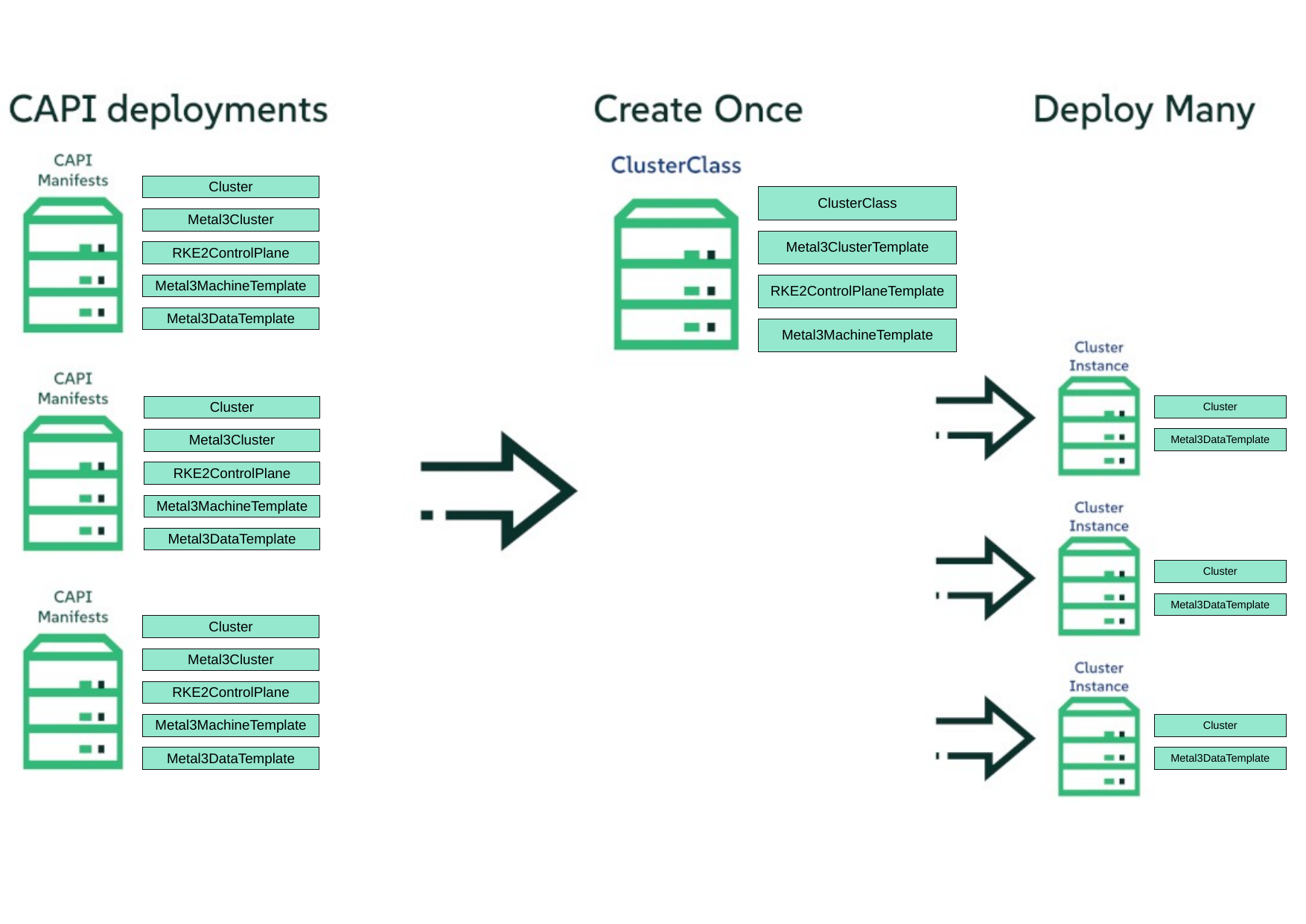
67.3 Example of current CAPI provisioning file #
Deploying a Kubernetes cluster leveraging Cluster API (CAPI) with the CAPRKE2 (control plane & bootstrap) and CAPM3 (infrastructure) providers requires you to define several custom resources. These resources define the desired state of the cluster and its underlying infrastructure, enabling CAPI to orchestrate the provisioning and management lifecycle. The code snippet below illustrates the resource types that must be configured to instantiate a Kubernetes cluster with only control plane nodes.:
Cluster: This resource encapsulates high-level configurations, including the network topology that will govern inter-node communication and service discovery. Furthermore, it establishes essential linkages to the control plane specification and the designated infrastructure provider resource, thereby informing CAPI about the desired cluster architecture and the underlying infrastructure upon which it will be provisioned.
Metal3Cluster: This resource defines infrastructure-level attributes unique to Metal3, for example the external endpoint through which the Kubernetes API server will be accessible.
RKE2ControlPlane: The RKE2ControlPlane resource defines the characteristics and behavior of the cluster’s control plane nodes. Within this specification, parameters such as the desired number of control plane replicas (crucial for ensuring high availability and fault tolerance), the specific Kubernetes distribution version (aligned with the chosen RKE2 release), and the strategy for rolling out updates to the control plane components are configured. Additionally, this resource dictates the Container Network Interface (CNI) to be employed within the cluster and facilitates the injection of agent-specific configurations, often leveraging Ignition for seamless and automated provisioning of the RKE2 agents on the control plane nodes.
Metal3MachineTemplate: This resource serves as a blueprint for creating the individual compute instances that form the cluster’s control plane nodes.
Metal3DataTemplate: Complementing the Metal3MachineTemplate, the Metal3DataTemplate resource enables additional metadata to be specified for the newly provisioned machine instances.
apiVersion: cluster.x-k8s.io/v1beta2
kind: Cluster
metadata:
  name: emea-spa-cluster-3
  namespace: emea-spa
  labels:
    cluster-api.cattle.io/rancher-auto-import: "true"
spec:
  clusterNetwork:
    pods:
      cidrBlocks:
        - 192.168.0.0/18
    services:
      cidrBlocks:
        - 10.96.0.0/12
  controlPlaneRef:
    apiGroup: controlplane.cluster.x-k8s.io
    kind: RKE2ControlPlane
    name: emea-spa-cluster-3
  infrastructureRef:
    apiGroup: infrastructure.cluster.x-k8s.io
    kind: Metal3Cluster
    name: emea-spa-cluster-3
---
apiVersion: infrastructure.cluster.x-k8s.io/v1beta2
kind: Metal3Cluster
metadata:
  name: emea-spa-cluster-3
  namespace: emea-spa
spec:
  controlPlaneEndpoint:
    host: 192.168.122.203
    port: 6443
  cloudProviderEnabled: false
---
apiVersion: controlplane.cluster.x-k8s.io/v1beta2
kind: RKE2ControlPlane
metadata:
  name: emea-spa-cluster-3
  namespace: emea-spa
spec:
  machineTemplate:
    spec:
      infrastructureRef:
        apiGroup: infrastructure.cluster.x-k8s.io
        kind: Metal3MachineTemplate
        name: emea-spa-cluster-3
  replicas: 1
  version: v1.36.3+rke2r1
  rolloutStrategy:
    type: "RollingUpdate"
    rollingUpdate:
      maxSurge: 1
  registrationMethod: "control-plane-endpoint"
  registrationAddress: 192.168.122.203
  serverConfig:
    cni: cilium
    cniMultusEnable: true
    tlsSan:
      - 192.168.122.203
      - https://192.168.122.203.sslip.io
  agentConfig:
    format: ignition
    additionalUserData:
      config: |
        variant: fcos
        version: 1.4.0
        storage:
          files:
            - path: /var/lib/rancher/rke2/server/manifests/endpoint-copier-operator.yaml
              overwrite: true
              contents:
                inline: |
                  apiVersion: helm.cattle.io/v1
                  kind: HelmChart
                  metadata:
                    name: endpoint-copier-operator
                    namespace: kube-system
                  spec:
                    chart: oci://registry.suse.com/edge/charts/endpoint-copier-operator
                    targetNamespace: endpoint-copier-operator
                    version: 307.0.1+up0.3.0
                    createNamespace: true
            - path: /var/lib/rancher/rke2/server/manifests/metallb.yaml
              overwrite: true
              contents:
                inline: |
                  apiVersion: helm.cattle.io/v1
                  kind: HelmChart
                  metadata:
                    name: metallb
                    namespace: kube-system
                  spec:
                    chart: oci://registry.suse.com/edge/charts/metallb
                    targetNamespace: metallb-system
                    version: 307.0.3+up0.16.1
                    createNamespace: true
            - path: /var/lib/rancher/rke2/server/manifests/metallb-cr.yaml
              overwrite: true
              contents:
                inline: |
                  apiVersion: metallb.io/v1beta1
                  kind: IPAddressPool
                  metadata:
                    name: kubernetes-vip-ip-pool
                    namespace: metallb-system
                  spec:
                    addresses:
                      - 192.168.122.203/32
                    serviceAllocation:
                      priority: 100
                      namespaces:
                        - default
                      serviceSelectors:
                        - matchExpressions:
                          - {key: "serviceType", operator: In, values: [kubernetes-vip]}
                  ---
                  apiVersion: metallb.io/v1beta1
                  kind: L2Advertisement
                  metadata:
                    name: ip-pool-l2-adv
                    namespace: metallb-system
                  spec:
                    ipAddressPools:
                      - kubernetes-vip-ip-pool
            - path: /var/lib/rancher/rke2/server/manifests/endpoint-svc.yaml
              overwrite: true
              contents:
                inline: |
                  apiVersion: v1
                  kind: Service
                  metadata:
                    name: kubernetes-vip
                    namespace: default
                    labels:
                      serviceType: kubernetes-vip
                  spec:
                    ports:
                    - name: rke2-api
                      port: 9345
                      protocol: TCP
                      targetPort: 9345
                    - name: k8s-api
                      port: 6443
                      protocol: TCP
                      targetPort: 6443
                    type: LoadBalancer
        systemd:
          units:
            - name: rke2-preinstall.service
              enabled: true
              contents: |
                [Unit]
                Description=rke2-preinstall
                Wants=network-online.target
                Before=rke2-install.service
                ConditionPathExists=!/run/cluster-api/bootstrap-success.complete
                [Service]
                Type=oneshot
                User=root
                ExecStartPre=/bin/sh -c "mount -L config-2 /mnt"
                # Note we use _ as a delimiter for sed here because the providerid includes / characters
                ExecStart=/bin/sh -c "sed -i \"s_PROVIDERID_$(jq -r .providerid /mnt/openstack/latest/meta_data.json)_\" /etc/rancher/rke2/config.yaml"
                ExecStart=/bin/sh -c "echo \"node-name: $(jq -r .name /mnt/openstack/latest/meta_data.json)\" >> /etc/rancher/rke2/config.yaml"
                ExecStart=/bin/sh -c "echo \"node-label:\" >> /etc/rancher/rke2/config.yaml"
                ExecStart=/bin/sh -c "echo \"  - metal3.io/uuid=$(jq -r .uuid /mnt/openstack/latest/meta_data.json)\" >> /etc/rancher/rke2/config.yaml"
                ExecStartPost=/bin/sh -c "umount /mnt"
                [Install]
                WantedBy=multi-user.target
    kubelet:
      extraArgs:
      - provider-id=metal3://PROVIDERID
    nodeName: "localhost.localdomain"
---
apiVersion: infrastructure.cluster.x-k8s.io/v1beta2
kind: Metal3MachineTemplate
metadata:
  name: emea-spa-cluster-3
  namespace: emea-spa
spec:
  nodeReuse: True
  template:
    spec:
      automatedCleaningMode: metadata
      dataTemplate:
        name: emea-spa-cluster-3
      hostSelector:
        matchLabels:
          cluster-role: control-plane
          deploy-region: emea-spa
          cluster-type: group-3
      image:
        checksum: http://fileserver.local:8080/eibimage-downstream-cluster.raw.sha256
        checksumType: sha256
        diskFormat: raw
        url: http://fileserver.local:8080/eibimage-downstream-cluster.raw
---
apiVersion: infrastructure.cluster.x-k8s.io/v1beta2
kind: Metal3DataTemplate
metadata:
  name: emea-spa-cluster-3
  namespace: emea-spa
spec:
  clusterName: emea-spa-cluster-3
  metaData:
    objectNames:
    - key: name
      object: machine
    - key: local-hostname
      object: machine
    - key: local_hostname
      object: machine

Adding the label cluster-api.cattle.io/rancher-auto-import: "true" to a Cluster API object in the cluster.x-k8s.io API group will import the cluster into Rancher (by creating a corresponding Rancher Cluster API object in the management.cattle.io API group).
See the Cluster API documentation for more information.
67.4 Transforming the CAPI provisioning file to ClusterClass #
67.4.1 ClusterClass definition #
The following code defines a ClusterClass resource, a declarative template for consistently deploying specific types of Kubernetes clusters. This specification includes common infrastructure and control plane configurations, enabling efficient provisioning and uniform lifecycle management across a cluster fleet. There are some variables defined in the following clusterclass example, that will be replaced during the cluster instantiation process using the real values requested for each cluster instance. The following variables are used in the example:
metallbHelmChartVersion: This optional variable allows to specify the version of theMetalLBHelm chart to be deployed in the cluster; when not provided, theMetalLBHelm chart will not be deployed.endpointCopierOperatorHelmChartVersion: This optional variable allows to specify the version of theEndpoint Copier OperatorHelm chart to be deployed in the cluster (when a version for theMetalLBHelm chart has been also provided); when not provided, theEndpoint Copier OperatorHelm chart will not be deployed.controlPlaneMachineTemplateImageURL: This required variable allows to specify the URL of the image to be used to provision the control plane machines.controlPlaneMachineTemplateHostSelectorDeployRegion: This required variable allows to specify thedeploy-regionhost selector value for the control plane machines.controlPlaneMachineTemplateHostSelectorClusterType: This required variable allows to specify thecluster-typehost selector value for the control plane machines.controlPlaneMachineTemplateDataTemplateName: This required variable allows to specify the name of theMetal3DataTemplateAPI object to use for the control plane machines.controlPlaneEndpointHost: This required variable allows to specify the host name or IP address of the control plane endpoint.tlsSan: This required variable allows to specify the list of TLS Subject Alternative Names for the control plane endpoint.
The clusterclass definition file consists of the following four resources:
ClusterClass: This resource encapsulates the entire cluster class definition, including the control plane and infrastructure templates. Moreover, it include the list of variables that will be replaced during the instantiation process (and defines the patches using them).
RKE2ControlPlaneTemplate: This resource defines the control plane template, specifying the desired configuration for the control plane nodes. Also, some parameters will be replaced with the right values during the instantiation process.
Metal3ClusterTemplate: This resource defines the infrastructure template, specifying the desired configuration for the underlying infrastructure. It includes parameters such as the control plane endpoint and the cloudProviderEnabled (true|false) flag. Also, some parameters will be replaced with the right values during the instantiation process.
Metal3MachineTemplate: This resource defines the machine template blueprint for the control plane nodes, providing the placeholders for those parameters to be replaced with the right values during the instantiation process.
apiVersion: controlplane.cluster.x-k8s.io/v1beta2
kind: RKE2ControlPlaneTemplate
metadata:
  name: example-controlplane
  namespace: emea-spa
spec:
  template:
    spec:
      rolloutStrategy:
        type: "RollingUpdate"
        rollingUpdate:
          maxSurge: 1
      registrationMethod: "control-plane-endpoint"
      registrationAddress: TO-BE-PATCHED-AUTOMATICALLY  # This will be replaced by the involved patch when applying the cluster instance
      serverConfig:
        cni: cilium
        cniMultusEnable: true
        tlsSan:
        - TO-BE-PATCHED-AUTOMATICALLY    # This will be replaced by the involved patch when applying the cluster instance
      agentConfig:
        format: ignition
        additionalUserData:
          config: |          # This will be replaced by the involved patch when applying the cluster instance
            TO-BE-PATCHED-AUTOMATICALLY
        kubelet:
          extraArgs:
          - provider-id=metal3://PROVIDERID
        nodeName: "localhost.localdomain"
---
apiVersion: infrastructure.cluster.x-k8s.io/v1beta2
kind: Metal3ClusterTemplate
metadata:
  name: example-cluster-template
  namespace: emea-spa
spec:
  template:
    spec:
      controlPlaneEndpoint:
        host: TO-BE-PATCHED-AUTOMATICALLY  # This will be replaced by the involved patch when applying the cluster instance
        port: 6443
      cloudProviderEnabled: false
---
apiVersion: infrastructure.cluster.x-k8s.io/v1beta2
kind: Metal3MachineTemplate
metadata:
  name: example-controlplane-machineinfrastructure
  namespace: emea-spa
spec:
  nodeReuse: true
  template:
    spec:
      automatedCleaningMode: metadata
      dataTemplate:
        name: to-be-patched-automatically  # This will be replaced by the involved patch when applying the cluster instance
      hostSelector:
        matchLabels:  # The labels used to identify the BMHs to select.
          cluster-role: control-plane
          deploy-region: TO-BE-PATCHED-AUTOMATICALLY # This will be replaced by the involved patch when applying the cluster instance
          cluster-type: TO-BE-PATCHED-AUTOMATICALLY  # This will be replaced by the involved patch when applying the cluster instance
      image:
        checksum: http://TO-BE-PATCHED-AUTOMATICALLY # This will be replaced by the involved patch when applying the cluster instance
        checksumType: sha256
        diskFormat: raw
        url: http://TO-BE-PATCHED-AUTOMATICALLY      # This will be replaced by the involved patch when applying the cluster instance
---
apiVersion: cluster.x-k8s.io/v1beta2
kind: ClusterClass
metadata:
  name: example-clusterclass
  namespace: emea-spa
spec:
  infrastructure:
    templateRef:
      kind: Metal3ClusterTemplate
      apiVersion: infrastructure.cluster.x-k8s.io/v1beta2
      name: example-cluster-template
  controlPlane:
    templateRef:
      kind: RKE2ControlPlaneTemplate
      apiVersion: controlplane.cluster.x-k8s.io/v1beta2
      name: example-controlplane
    machineInfrastructure:
      templateRef:
        kind: Metal3MachineTemplate
        apiVersion: infrastructure.cluster.x-k8s.io/v1beta2
        name: example-controlplane-machineinfrastructure
  variables:
  - name: metallbHelmChartVersion
    required: false
    schema:
      openAPIV3Schema:
        type: string
  - name: endpointCopierOperatorHelmChartVersion
    required: false
    schema:
      openAPIV3Schema:
        type: string
  - name: controlPlaneMachineTemplateImageURL
    required: true
    schema:
      openAPIV3Schema:
        type: string
  - name: controlPlaneMachineTemplateHostSelectorDeployRegion
    required: true
    schema:
      openAPIV3Schema:
        type: string
  - name: controlPlaneMachineTemplateHostSelectorClusterType
    required: true
    schema:
      openAPIV3Schema:
        type: string
  - name: controlPlaneMachineTemplateDataTemplateName
    required: true
    schema:
      openAPIV3Schema:
        type: string
  - name: controlPlaneEndpointHost
    required: true
    schema:
      openAPIV3Schema:
        type: string
  - name: tlsSan
    required: true
    schema:
      openAPIV3Schema:
        type: array
        items:
          type: string
  patches:
  - name: setControlPlaneMachineTemplateImageURL
    definitions:
    - selector:
        apiVersion: infrastructure.cluster.x-k8s.io/v1beta2
        kind: Metal3MachineTemplate
        matchResources:
          controlPlane: true        # Added to select ControlPlane
      jsonPatches:
      - op: replace
        path: "/spec/template/spec/image/url"
        valueFrom:
          variable: controlPlaneMachineTemplateImageURL
      - op: replace
        path: "/spec/template/spec/image/checksum"
        valueFrom:
          template: "{{ .controlPlaneMachineTemplateImageURL }}.sha256"
  - name: setControlPlaneMachineTemplateHostSelectorDeployRegion
    definitions:
    - selector:
        apiVersion: infrastructure.cluster.x-k8s.io/v1beta2
        kind: Metal3MachineTemplate
        matchResources:
          controlPlane: true
      jsonPatches:
      - op: replace
        path: "/spec/template/spec/hostSelector/matchLabels/deploy-region"
        valueFrom:
          variable: controlPlaneMachineTemplateHostSelectorDeployRegion
  - name: setControlPlaneMachineTemplateHostSelectorClusterType
    definitions:
    - selector:
        apiVersion: infrastructure.cluster.x-k8s.io/v1beta2
        kind: Metal3MachineTemplate
        matchResources:
          controlPlane: true        # Added to select ControlPlane
      jsonPatches:
      - op: replace
        path: "/spec/template/spec/hostSelector/matchLabels/cluster-type"
        valueFrom:
          variable: controlPlaneMachineTemplateHostSelectorClusterType
  - name: setControlPlaneMachineTemplateDataTemplateName
    definitions:
    - selector:
        apiVersion: infrastructure.cluster.x-k8s.io/v1beta2
        kind: Metal3MachineTemplate
        matchResources:
          controlPlane: true        # Added to select ControlPlane
      jsonPatches:
      - op: replace
        path: "/spec/template/spec/dataTemplate/name"
        valueFrom:
          variable: controlPlaneMachineTemplateDataTemplateName
  - name: setControlPlaneEndpoint
    definitions:
    - selector:
        apiVersion: infrastructure.cluster.x-k8s.io/v1beta2
        kind: Metal3ClusterTemplate
        matchResources:
          infrastructureCluster: true  # Added to select InfraCluster
      jsonPatches:
      - op: replace
        path: "/spec/template/spec/controlPlaneEndpoint/host"
        valueFrom:
          variable: controlPlaneEndpointHost
  - name: setRegistrationAddress
    definitions:
    - selector:
        apiVersion: controlplane.cluster.x-k8s.io/v1beta2
        kind: RKE2ControlPlaneTemplate
        matchResources:
          controlPlane: true        # Added to select ControlPlane
      jsonPatches:
      - op: replace
        path: "/spec/template/spec/registrationAddress"
        valueFrom:
          variable: controlPlaneEndpointHost
  - name: setTlsSan
    definitions:
    - selector:
        apiVersion: controlplane.cluster.x-k8s.io/v1beta2
        kind: RKE2ControlPlaneTemplate
        matchResources:
          controlPlane: true        # Added to select ControlPlane
      jsonPatches:
      - op: replace
        path: "/spec/template/spec/serverConfig/tlsSan"
        valueFrom:
          variable: tlsSan
  - name: updateAdditionalUserData
    definitions:
    - selector:
        apiVersion: controlplane.cluster.x-k8s.io/v1beta2
        kind: RKE2ControlPlaneTemplate
        matchResources:
          controlPlane: true
      jsonPatches:
      - op: replace
        path: "/spec/template/spec/agentConfig/additionalUserData"
        valueFrom:
          template: |
            config: |
              variant: fcos
              version: 1.4.0
              {{ if .metallbHelmChartVersion }}
              storage:
                files:
                - path: /var/lib/rancher/rke2/server/manifests/metallb.yaml
                  overwrite: true
                  contents:
                    inline: |
                      apiVersion: helm.cattle.io/v1
                      kind: HelmChart
                      metadata:
                        name: metallb
                        namespace: kube-system
                      spec:
                        chart: oci://registry.suse.com/edge/charts/metallb
                        targetNamespace: metallb-system
                        version: {{ .metallbHelmChartVersion }}
                        createNamespace: true
                {{ if .endpointCopierOperatorHelmChartVersion }}
                - path: /var/lib/rancher/rke2/server/manifests/endpoint-copier-operator.yaml
                  overwrite: true
                  contents:
                    inline: |
                      apiVersion: helm.cattle.io/v1
                      kind: HelmChart
                      metadata:
                        name: endpoint-copier-operator
                        namespace: kube-system
                      spec:
                        chart: oci://registry.suse.com/edge/charts/endpoint-copier-operator
                        targetNamespace: endpoint-copier-operator
                        version: {{ .endpointCopierOperatorHelmChartVersion }}
                        createNamespace: true
                - path: /var/lib/rancher/rke2/server/manifests/metallb-cr.yaml
                  overwrite: true
                  contents:
                    inline: |
                      apiVersion: metallb.io/v1beta1
                      kind: IPAddressPool
                      metadata:
                        name: kubernetes-vip-ip-pool
                        namespace: metallb-system
                      spec:
                        addresses:
                          - {{ .controlPlaneEndpointHost }}/32
                        serviceAllocation:
                          priority: 100
                          namespaces:
                            - default
                          serviceSelectors:
                            - matchExpressions:
                              - {key: "serviceType", operator: In, values: [kubernetes-vip]}
                      ---
                      apiVersion: metallb.io/v1beta1
                      kind: L2Advertisement
                      metadata:
                        name: ip-pool-l2-adv
                        namespace: metallb-system
                      spec:
                        ipAddressPools:
                          - kubernetes-vip-ip-pool
                - path: /var/lib/rancher/rke2/server/manifests/endpoint-svc.yaml
                  overwrite: true
                  contents:
                    inline: |
                      apiVersion: v1
                      kind: Service
                      metadata:
                        name: kubernetes-vip
                        namespace: default
                        labels:
                          serviceType: kubernetes-vip
                      spec:
                        ports:
                        - name: rke2-api
                          port: 9345
                          protocol: TCP
                          targetPort: 9345
                        - name: k8s-api
                          port: 6443
                          protocol: TCP
                          targetPort: 6443
                        type: LoadBalancer
                {{ end }}
              {{ end }}
              systemd:
                units:
                - name: rke2-preinstall.service
                  enabled: true
                  contents: |
                    [Unit]
                    Description=rke2-preinstall
                    Wants=network-online.target
                    Before=rke2-install.service
                    ConditionPathExists=!/run/cluster-api/bootstrap-success.complete
                    [Service]
                    Type=oneshot
                    User=root
                    ExecStartPre=/bin/sh -c "mount -L config-2 /mnt"
                    # Note we use _ as a delimiter for sed here because the providerid includes / characters
                    ExecStart=/bin/sh -c "sed -i \"s_PROVIDERID_$(jq -r .providerid /mnt/openstack/latest/meta_data.json)_\" /etc/rancher/rke2/config.yaml"
                    ExecStart=/bin/sh -c "echo \"node-name: $(jq -r .name /mnt/openstack/latest/meta_data.json)\" >> /etc/rancher/rke2/config.yaml"
                    ExecStart=/bin/sh -c "echo \"node-label:\" >> /etc/rancher/rke2/config.yaml"
                    ExecStart=/bin/sh -c "echo \"  - metal3.io/uuid=$(jq -r .uuid /mnt/openstack/latest/meta_data.json)\" >> /etc/rancher/rke2/config.yaml"
                    ExecStartPost=/bin/sh -c "umount /mnt"
                    [Install]
                    WantedBy=multi-user.target
67.4.2 Cluster instance definition #
Within the context of ClusterClass, a cluster instance refers to a specific, running instantiation of a cluster that has been created based on a defined ClusterClass. It represents a concrete deployment with its unique configurations, resources, and operational state, directly derived from the blueprint specified in the ClusterClass. This includes the specific set of machines, networking configurations, and associated Kubernetes components that are actively running. Understanding the cluster instance is crucial for managing the lifecycle, performing upgrades, executing scaling operations, and conducting monitoring of a particular deployed cluster that was provisioned using the ClusterClass framework.
To define a cluster instance we need to define the following two resources:
Cluster: This resource represents the actual cluster instance, including a reference to its
topology(i.e.,ClusterClassobject), the required Kubernetes version, the number of control plane nodes to instantiate and the values provided to each of the variables defined in the referencedClusterClass, which will be used during the instantiation process.Metal3DataTemplate: This resource provides additional metadata for the machines in the cluster (control plane machines only in this example), complementing the
Metal3MachineTemplateobject automatically created per each instantiated cluster. Note that it is not possible to define a singleMetal3DataTemplateresource valid for all clusters instantiated from a commonClusterClass, since theclusterNamefield in theMetal3DataTemplatespecification must reference the specific cluster instance to which it "belongs".apiVersion: cluster.x-k8s.io/v1beta2 kind: Cluster metadata: name: emea-spa-cluster-3 namespace: emea-spa labels: cluster-api.cattle.io/rancher-auto-import: "true" spec: topology: classRef: name: example-clusterclass namespace: emea-spa version: v1.36.3+rke2r1 controlPlane: replicas: 1 variables: # Values to be replaced in the clusterclass template variables to create this specific cluster - name: endpointCopierOperatorHelmChartVersion value: 307.0.1+up0.3.0 - name: metallbHelmChartVersion value: 307.0.3+up0.16.1 - name: controlPlaneMachineTemplateImageURL value: http://fileserver.local:8080/eibimage-downstream-cluster.raw.sha256 - name: controlPlaneMachineTemplateHostSelectorDeployRegion value: emea-spa - name: controlPlaneMachineTemplateHostSelectorClusterType value: group-3 - name: controlPlaneMachineTemplateDataTemplateName value: emea-spa-cluster-3 - name: controlPlaneEndpointHost value: 192.168.122.203 - name: tlsSan value: - 192.168.122.203 - https://192.168.122.203.sslip.io --- apiVersion: infrastructure.cluster.x-k8s.io/v1beta2 kind: Metal3DataTemplate metadata: name: emea-spa-cluster-3 namespace: emea-spa spec: clusterName: emea-spa-cluster-3 metaData: objectNames: - key: name object: machine - key: local-hostname object: machine - key: local_hostname object: machine
Adding the label cluster-api.cattle.io/rancher-auto-import: "true" to a Cluster API object in the cluster.x-k8s.io API group will import the cluster into Rancher (by creating a corresponding Rancher Cluster API object in the management.cattle.io API group).
See the Cluster API documentation for more information.
This approach streamlines the process, allowing you to deploy a cluster using only two resources once the clusterclass blueprints are defined.