
53 Downstream cluster provisioning with Directed network provisioning (multi-node) #
This section describes the workflow used to automate the provisioning of a multi-node downstream cluster using directed network provisioning and MetalLB as a load-balancer strategy.
This is the simplest way to automate the provisioning of a downstream cluster. The following diagram shows the workflow used to automate the provisioning of a multi-node downstream cluster using directed network provisioning and MetalLB.
Requirements
The image generated using
EIB, as described in the previous section (Chapter 50, Prepare downstream cluster image for connected scenarios), with the minimal configuration to set up the downstream cluster has to be located in the management cluster exactly on the path you configured on this section (Note).The management server created and available to be used on the following sections. For more information, refer to the Management Cluster section: Part V, “Setting up the management cluster”.
Workflow
The following diagram shows the workflow used to automate the provisioning of a multi-node downstream cluster using directed network provisioning:
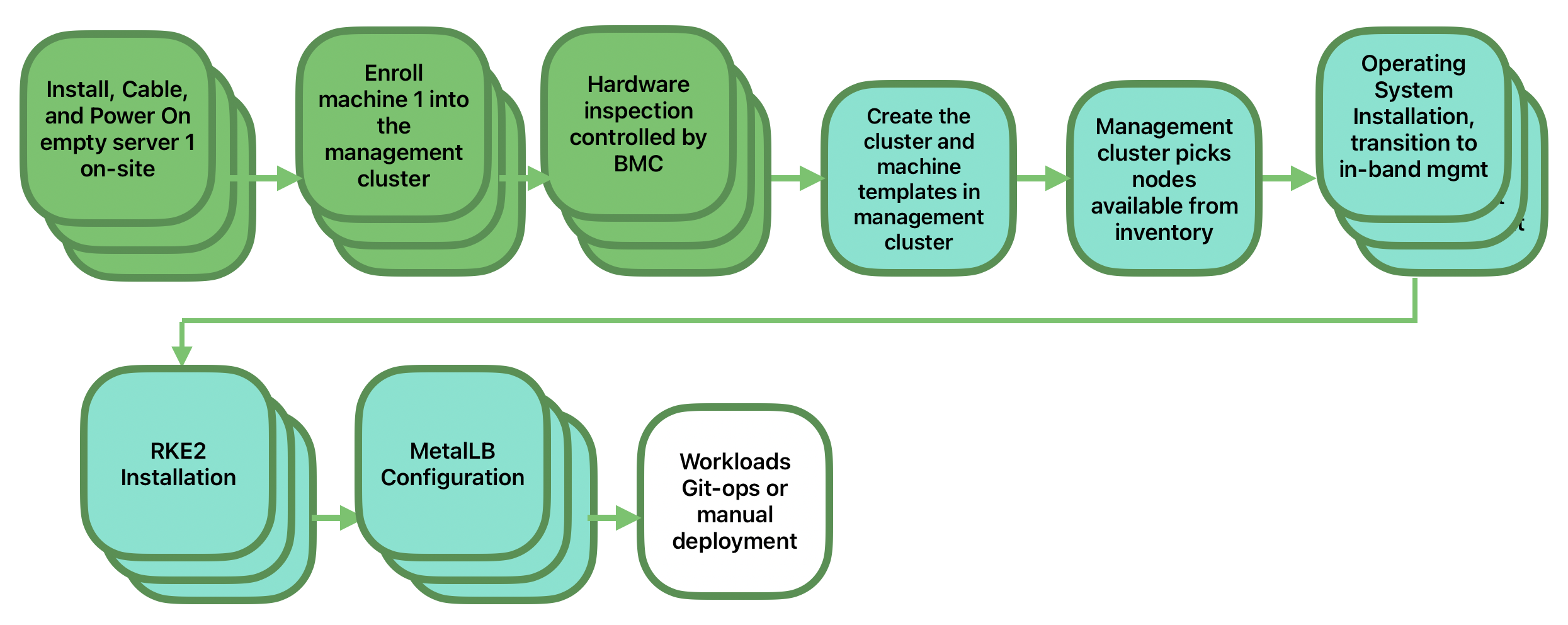
Enroll the three bare-metal hosts to make them available for the provisioning process.
Provision the three bare-metal hosts to install and configure the operating system and the Kubernetes cluster using
MetalLB.
Enroll the bare-metal hosts
The first step is to enroll the three bare-metal hosts in the management cluster to make them available to be provisioned.
To do that, the following files (bmh-example-node1.yaml, bmh-example-node2.yaml and bmh-example-node3.yaml) must be created in the management cluster, to specify the BMC credentials to be used and the BaremetalHost object to be enrolled in the management cluster.

Only the values between
$\{…\}have to be replaced with the real values.We will walk you through the process for only one host. The same steps apply to the other two nodes.
apiVersion: v1
kind: Secret
metadata:
  name: node1-example-credentials
type: Opaque
data:
  username: ${BMC_NODE1_USERNAME}
  password: ${BMC_NODE1_PASSWORD}
---
apiVersion: metal3.io/v1alpha1
kind: BareMetalHost
metadata:
  name: node1-example
  labels:
    cluster-role: control-plane
spec:
  architecture: x86_64
  online: true
  bootMACAddress: ${BMC_NODE1_MAC}
  bmc:
    address: ${BMC_NODE1_ADDRESS}
    disableCertificateVerification: true
    credentialsName: node1-example-credentials
Where:
${BMC_NODE1_USERNAME}— The username for the BMC of the first bare-metal host.${BMC_NODE1_PASSWORD}— The password for the BMC of the first bare-metal host.${BMC_NODE1_MAC}— The MAC address of the first bare-metal host to be used.${BMC_NODE1_ADDRESS}— The URL for the first bare-metal host BMC (for example,redfish-virtualmedia://192.168.200.75/redfish/v1/Systems/1/). The host part of the URL can be an IP address (v4 or v6) or a domain name, where the existing infrastructure allows. To learn more about the different options available depending on your hardware provider, check the following link.
If no network configuration for the host has been specified, either at image build time or through the
BareMetalHostdefinition, an autoconfiguration mechanism (DHCP, DHCPv6, SLAAC) will be used. For more details or complex configurations, check the Chapter 54, Advanced Network Configuration.Single-stack IPv6 clusters require a dual-stack management cluster.
Architecture must be either
x86_64oraarch64, depending on the architecture of the bare-metal host to be enrolled.All modern servers come with a dual-stack capable BMC, however IPv6 support (and possibly the option of using hostnames for the VirtualMedia capability) should be verified before use in production in a dual-stack environment.
Once the file is created, the following command must be executed in the management cluster to start enrolling the bare-metal hosts in the management cluster:
$ kubectl apply -f bmh-example-node1.yaml
$ kubectl apply -f bmh-example-node2.yaml
$ kubectl apply -f bmh-example-node3.yaml
The new bare-metal host objects are enrolled, changing their state from registering to inspecting and available. The changes can be checked using the following command:
$ kubectl get bmh -o wideThe BaremetalHost object is in the registering state until the BMC credentials are validated. Once the credentials are validated, the BaremetalHost object changes its state to inspecting, and this step could take some time depending on the hardware (up to 20 minutes). During the inspecting phase, the hardware information is retrieved and the Kubernetes object is updated. Check the information using the following command: kubectl get bmh -o yaml.
Provision step
Once the three bare-metal hosts are enrolled and available, the next step is to provision the bare-metal hosts to install and configure the operating system and the Kubernetes cluster, creating a load balancer to manage them.
To do that, the following file (capi-provisioning-example.yaml) must be created in the management cluster with the following information (the `capi-provisioning-example.yaml can be generated by joining the following blocks).
Only values between
$\{…\}must be replaced with the real values.The
VIPaddress is a reserved IP address that is not assigned to any node and is used to configure the load balancer. In a dual-stack cluster, both an IPv4 and IPv6 can be specified, but in the following examples priority will be given to the IPv4 address.
Below is the cluster definition, where the cluster network can be configured using the pods and the services blocks. Also, it contains the references to the control plane and the infrastructure (using the Metal3 provider) objects to be used.
apiVersion: cluster.x-k8s.io/v1beta2
kind: Cluster
metadata:
  name: multinode-cluster
  namespace: default
  labels:
    cluster-api.cattle.io/rancher-auto-import: "true"
spec:
  clusterNetwork:
    pods:
      cidrBlocks:
        - 192.168.0.0/18
        - fd00:1234:4321::/48
    services:
      cidrBlocks:
        - 10.96.0.0/12
        - fd00:5678:8765:4321::/112
  controlPlaneRef:
    apiGroup: controlplane.cluster.x-k8s.io
    kind: RKE2ControlPlane
    name: multinode-cluster
  infrastructureRef:
    apiGroup: infrastructure.cluster.x-k8s.io
    kind: Metal3Cluster
name: multinode-clusterBoth single-stack and dual-stack deployments are possible, remove the IPv6 CIDRs and IPv6 VIP addresses (in the subsequent sections) for an IPv4 only cluster.
Adding the label
cluster-api.cattle.io/rancher-auto-import: "true"to thecluster.x-k8s.ioobjects will import the cluster into Rancher (by creating a correspondingclusters.management.cattle.ioobject). See the Cluster API documentation for more information.
The Metal3Cluster object specifies the control-plane endpoint that uses the VIP address already reserved (replacing the ${EDGE_VIP_ADDRESS_IPV4}) to be configured and the cloudProviderEnabled flag set to false because the three bare-metal nodes are used.
apiVersion: infrastructure.cluster.x-k8s.io/v1beta2
kind: Metal3Cluster
metadata:
  name: multinode-cluster
  namespace: default
spec:
  controlPlaneEndpoint:
    host: ${EDGE_VIP_ADDRESS_IPV4}
    port: 6443
  cloudProviderEnabled: false
The RKE2ControlPlane object specifies the control-plane configuration to be used, and the Metal3MachineTemplate object specifies the control-plane image to be used.
A load balancer exclusion annotation that informs external load balancers like MetalLB that a node is going to be drained during lifecycle operations like upgrades of downstream clusters. For details see: Section 60.1, “Load Balancer Exclusion”
The number of replicas to be used (in this case, three).
The advertisement mode to be used by the Load Balancer (
addressuses the L2 implementation), as well as the address to be used (replacing the${EDGE_VIP_ADDRESS}with theVIPaddress).The
serverConfigwith theCNIplug-in to be used (in this case,Cilium), and the additionalVIPaddress(es) and name(s) to be listed undertlsSan.The agentConfig block contains the
Ignitionformat to be used and theadditionalUserDatato be used to configure theRKE2node with information like:The systemd service named
rke2-preinstall.serviceto replace automatically thePROVIDERIDandnode-nameduring the provisioning process using the Ironic information plus adding themetal3.io/uuidlabel to Node objects with theBareMetalHostUUID.The
storageblock which contains the required manifests to install theMetalLBand theendpoint-copier-operatorHelm chats.The
metalLBcustom resource file including theIPaddressPooland theL2Advertisementused to externally expose the API server for this download cluster through the configuredVIPaddress (replacing${EDGE_VIP_ADDRESS_IPV4}with that selectedVIPaddress).The
endpoint-svc.yamlfile to be used to configure thekubernetes-vipservice to be exposed byMetalLBthrough the configuredVIPaddress.The
rke2-traefik-config.yamlfile providing the deployment configuration for theRKE2built-inrke2-traefikHelm chart .The
metallb-traefik-cr.yamlfile containing theMetalLBcustom resources (IPAddressPoolandL2Advertisement) instance manifests required to externally expose the Ingress service through the${INGRESS_IPV4}and${INGRESS_IPV6}Virtual IPs
The last block of information contains the Kubernetes version to be used. The
${RKE2_VERSION}is the version ofRKE2to be used replacing this value (for example,v1.36.3+rke2r1).
apiVersion: controlplane.cluster.x-k8s.io/v1beta2
kind: RKE2ControlPlane
metadata:
  name: multinode-cluster
  namespace: default
  annotations: {
    rke2.controlplane.cluster.x-k8s.io/load-balancer-exclusion: "true"
  }
spec:
  infrastructureRef:
    apiGroup: infrastructure.cluster.x-k8s.io
    kind: Metal3MachineTemplate
    name: multinode-cluster-controlplane
  replicas: 3
  version: ${RKE2_VERSION}
  rolloutStrategy:
    type: "RollingUpdate"
    rollingUpdate:
      maxSurge: 0
  registrationMethod: "control-plane-endpoint"
  registrationAddress: ${EDGE_VIP_ADDRESS}
  serverConfig:
    cni: cilium
    tlsSan:
      - ${EDGE_VIP_ADDRESS_IPV4}
      - ${EDGE_VIP_ADDRESS_IPV6}
      - https://${EDGE_VIP_ADDRESS_IPV4}.sslip.io
      - https://${EDGE_VIP_ADDRESS_IPV6}.sslip.io
  agentConfig:
    format: ignition
    additionalUserData:
      config: |
        variant: fcos
        version: 1.4.0
        systemd:
          units:
          - name: rke2-preinstall.service
            enabled: true
            contents: |
              [Unit]
              Description=rke2-preinstall
              Wants=network-online.target
              Before=rke2-install.service
              ConditionPathExists=!/run/cluster-api/bootstrap-success.complete
              [Service]
              Type=oneshot
              User=root
              ExecStartPre=/bin/sh -c "mount -L config-2 /mnt"
              # Note we use _ as a delimiter for sed here because the providerid includes / characters
              ExecStart=/bin/sh -c "sed -i \"s_PROVIDERID_$(jq -r .providerid /mnt/openstack/latest/meta_data.json)_\" /etc/rancher/rke2/config.yaml"
              ExecStart=/bin/sh -c "echo \"node-name: $(jq -r .name /mnt/openstack/latest/meta_data.json)\" >> /etc/rancher/rke2/config.yaml"
              ExecStart=/bin/sh -c "echo \"node-label:\" >> /etc/rancher/rke2/config.yaml"
              ExecStart=/bin/sh -c "echo \"  - metal3.io/uuid=$(jq -r .uuid /mnt/openstack/latest/meta_data.json)\" >> /etc/rancher/rke2/config.yaml"
              ExecStartPost=/bin/sh -c "umount /mnt"
              [Install]
              WantedBy=multi-user.target
        storage:
          directories:
          - path: /var/lib/rancher/rke2/server/manifests
            overwrite: true
          files:
            # https://docs.rke2.io/networking/multus_sriov#using-multus-with-cilium
            - path: /var/lib/rancher/rke2/server/manifests/rke2-cilium-config.yaml
              overwrite: true
              contents:
                inline: |
                  apiVersion: helm.cattle.io/v1
                  kind: HelmChartConfig
                  metadata:
                    name: rke2-cilium
                    namespace: kube-system
                  spec:
                    valuesContent: |-
                      cni:
                        exclusive: false
              mode: 0644
              user:
                name: root
              group:
                name: root
            - path: /var/lib/rancher/rke2/server/manifests/endpoint-copier-operator.yaml
              overwrite: true
              contents:
                inline: |
                  apiVersion: helm.cattle.io/v1
                  kind: HelmChart
                  metadata:
                    name: endpoint-copier-operator
                    namespace: kube-system
                  spec:
                    chart: oci://registry.suse.com/edge/charts/endpoint-copier-operator
                    targetNamespace: endpoint-copier-operator
                    version: 307.0.1+up0.3.0
                    createNamespace: true
            - path: /var/lib/rancher/rke2/server/manifests/metallb.yaml
              overwrite: true
              contents:
                inline: |
                  apiVersion: helm.cattle.io/v1
                  kind: HelmChart
                  metadata:
                    name: metallb
                    namespace: kube-system
                  spec:
                    chart: oci://registry.suse.com/edge/charts/metallb
                    targetNamespace: metallb-system
                    version: 307.0.3+up0.16.1
                    createNamespace: true

            - path: /var/lib/rancher/rke2/server/manifests/metallb-cr.yaml
              overwrite: true
              contents:
                inline: |
                  apiVersion: metallb.io/v1beta1
                  kind: IPAddressPool
                  metadata:
                    name: kubernetes-vip-ip-pool
                    namespace: metallb-system
                  spec:
                    addresses:
                      - ${EDGE_VIP_ADDRESS_IPV4}/32
                      - ${EDGE_VIP_ADDRESS_IPV6}/128
                    serviceAllocation:
                      priority: 100
                      namespaces:
                        - default
                      serviceSelectors:
                        - matchExpressions:
                          - {key: "serviceType", operator: In, values: [kubernetes-vip]}
                  ---
                  apiVersion: metallb.io/v1beta1
                  kind: L2Advertisement
                  metadata:
                    name: ip-pool-l2-adv
                    namespace: metallb-system
                  spec:
                    ipAddressPools:
                      - kubernetes-vip-ip-pool
            - path: /var/lib/rancher/rke2/server/manifests/endpoint-svc.yaml
              overwrite: true
              contents:
                inline: |
                  apiVersion: v1
                  kind: Service
                  metadata:
                    name: kubernetes-vip
                    namespace: default
                    labels:
                      serviceType: kubernetes-vip
                  spec:
                    ipFamilyPolicy: PreferDualStack
                    ports:
                    - name: rke2-api
                      port: 9345
                      protocol: TCP
                      targetPort: 9345
                    - name: k8s-api
                      port: 6443
                      protocol: TCP
                      targetPort: 6443
                    type: LoadBalancer
          - path: /var/lib/rancher/rke2/server/manifests/rke2-traefik-config.yaml
            overwrite: true
            contents:
              inline: |
                apiVersion: helm.cattle.io/v1
                kind: HelmChartConfig
                metadata:
                  name: rke2-traefik
                  namespace: kube-system
                spec:
                  valuesContent: |-
                    ingressClass:
                      isDefaultClass: true
                    ports:
                      web:
                        hostPort: null    # disallow hostPort
                        exposedPort: 80
                      websecure:
                        hostPort: null    # disallow hostPort
                        exposedPort: 443
                    service:
                      enabled: true
                      spec:
                        type: LoadBalancer
                        externalTrafficPolicy: Local
                        allocateLoadBalancerNodePorts: false
            mode: 0644
            user:
              name: root
            group:
              name: root
            mode: 0644
            user:
              name: root
            group:
              name: root
          - path: /var/lib/rancher/rke2/server/manifests/metallb-traefik-cr.yaml
            overwrite: true
            contents:
              inline: |
                apiVersion: metallb.io/v1beta1
                kind: IPAddressPool
                metadata:
                  name: ingress-ippool
                  namespace: metallb-system
                spec:
                  addresses:
                    - ${INGRESS_IPV4}/32
                    - ${INGRESS_IPV6}/128
                  serviceAllocation:
                    priority: 100
                    serviceSelectors:
                    - matchExpressions:
                      - {key: app.kubernetes.io/name, operator: In, values: [rke2-traefik]} # assign to rke2-traefik LB svc
                ---
                apiVersion: metallb.io/v1beta1
                kind: L2Advertisement
                metadata:
                  name: ingress-l2-adv
                  namespace: metallb-system
                spec:
                  ipAddressPools:
                    - ingress-ippool
            mode: 0644
            user:
              name: root
            group:
              name: root
    kubelet:
      extraArgs:
      - provider-id=metal3://PROVIDERID
    nodeName: "Node-multinode-cluster"
The Metal3MachineTemplate object specifies the following information:
The
dataTemplateto be used as a reference to the template.The
hostSelectorto be used matching with the label created during the enrollment process.The
imageto be used as a reference to the image generated usingEIBon the previous section (Chapter 50, Prepare downstream cluster image for connected scenarios), andchecksumandchecksumTypeto be used to validate the image.
apiVersion: infrastructure.cluster.x-k8s.io/v1beta2
kind: Metal3MachineTemplate
metadata:
  name: multinode-cluster-controlplane
  namespace: default
spec:
  template:
    spec:
      dataTemplate:
        name: multinode-cluster-controlplane-template
      hostSelector:
        matchLabels:
          cluster-role: control-plane
      image:
        checksum: http://imagecache.local:8080/eibimage-output-telco.raw.sha256
        checksumType: sha256
        diskFormat: raw
        url: http://imagecache.local:8080/eibimage-output-telco.raw
The Metal3DataTemplate object specifies the metaData for the downstream cluster.
apiVersion: infrastructure.cluster.x-k8s.io/v1beta2
kind: Metal3DataTemplate
metadata:
  name: multinode-cluster-controlplane-template
  namespace: default
spec:
  clusterName: multinode-cluster
  metaData:
    objectNames:
    - key: name
      object: machine
    - key: local-hostname
      object: machine
    - key: local_hostname
      object: machine
The following yaml files are an example configuration for the worker nodes.
A MachineDeployment:
apiVersion: cluster.x-k8s.io/v1beta2
kind: MachineDeployment
metadata:
  labels:
    cluster.x-k8s.io/cluster-name: multinode-cluster
    nodepool: nodepool-0
  name: multinode-cluster-workers
  namespace: default
spec:
  clusterName: multinode-cluster
  replicas: 3
  selector:
    matchLabels:
      cluster.x-k8s.io/cluster-name: multinode-cluster
      nodepool: nodepool-0
  template:
    metadata:
      labels:
        cluster.x-k8s.io/cluster-name: multinode-cluster
        nodepool: nodepool-0
    spec:
      bootstrap:
        configRef:
          apiGroup: bootstrap.cluster.x-k8s.io
          kind: RKE2ConfigTemplate
          name: multinode-cluster-workers
      clusterName: multinode-cluster
      infrastructureRef:
        apiGroup: infrastructure.cluster.x-k8s.io
        kind: Metal3MachineTemplate
        name: multinode-cluster-workers
      deletion:
        nodeDrainTimeoutSeconds: 0
      version: ${RKE2_VERSION}
The RKE2ConfigTemplate` object specifies the configuration template to be used for multinode cluster worker nodes.
apiVersion: bootstrap.cluster.x-k8s.io/v1beta2
kind: RKE2ConfigTemplate
metadata:
  name: multinode-cluster-workers
  namespace: default
spec:
  template:
    spec:
      agentConfig:
        format: ignition
        kubelet:
          extraArgs:
          - provider-id=metal3://PROVIDERID
        nodeName: "Node-multinode-cluster-worker"
        additionalUserData:
          config: |
            variant: fcos
            version: 1.4.0
            systemd:
              units:
              - name: rke2-preinstall.service
                enabled: true
                contents: |
                  [Unit]
                  Description=rke2-preinstall
                  Wants=network-online.target
                  Before=rke2-install.service
                  ConditionPathExists=!/run/cluster-api/bootstrap-success.complete
                  [Service]
                  Type=oneshot
                  User=root
                  ExecStartPre=/bin/sh -c "mount -L config-2 /mnt"
                  # Note we use _ as a delimiter for sed here because the providerid includes / characters
                  ExecStart=/bin/sh -c "sed -i \"s_PROVIDERID_$(jq -r .providerid /mnt/openstack/latest/meta_data.json)_\" /etc/rancher/rke2/config.yaml"
                  ExecStart=/bin/sh -c "echo \"node-name: $(jq -r .name /mnt/openstack/latest/meta_data.json)\" >> /etc/rancher/rke2/config.yaml"
                  ExecStart=/bin/sh -c "echo \"node-label:\" >> /etc/rancher/rke2/config.yaml"
                  ExecStart=/bin/sh -c "echo \"  - metal3.io/uuid=$(jq -r .uuid /mnt/openstack/latest/meta_data.json)\" >> /etc/rancher/rke2/config.yaml"
                  ExecStartPost=/bin/sh -c "umount /mnt"
                  [Install]
                  WantedBy=multi-user.target
The Metal3MachineTemplate object contain references to dataTemplate, hostSelector, and image for the worker nodes:
apiVersion: infrastructure.cluster.x-k8s.io/v1beta2
kind: Metal3MachineTemplate
metadata:
  name: multinode-cluster-workers
  namespace: default
spec:
  template:
    spec:
      dataTemplate:
        name: multinode-cluster-workers-template
      hostSelector:
        matchLabels:
          cluster-role: worker
      image:
        checksum: http://imagecache.local:8080/eibimage-slmicro-rt-telco.raw.sha256
        checksumType: sha256
        diskFormat: raw
        url: http://imagecache.local:8080/eibimage-slmicro-rt-telco.raw
The Metal3DataTemplate object specifies the metaData for the downstream cluster for the worker nodes:
apiVersion: infrastructure.cluster.x-k8s.io/v1beta2
kind: Metal3DataTemplate
metadata:
  name: multinode-cluster-workers-template
  namespace: default
spec:
  clusterName: multinode-cluster
  metaData:
    objectNames:
    - key: name
      object: machine
    - key: local-hostname
      object: machine
    - key: local_hostname
      object: machine
Once the file is created by joining the previous blocks, run the following command in the management cluster to start provisioning the new three bare-metal hosts:
$ kubectl apply -f capi-provisioning-example.yaml